









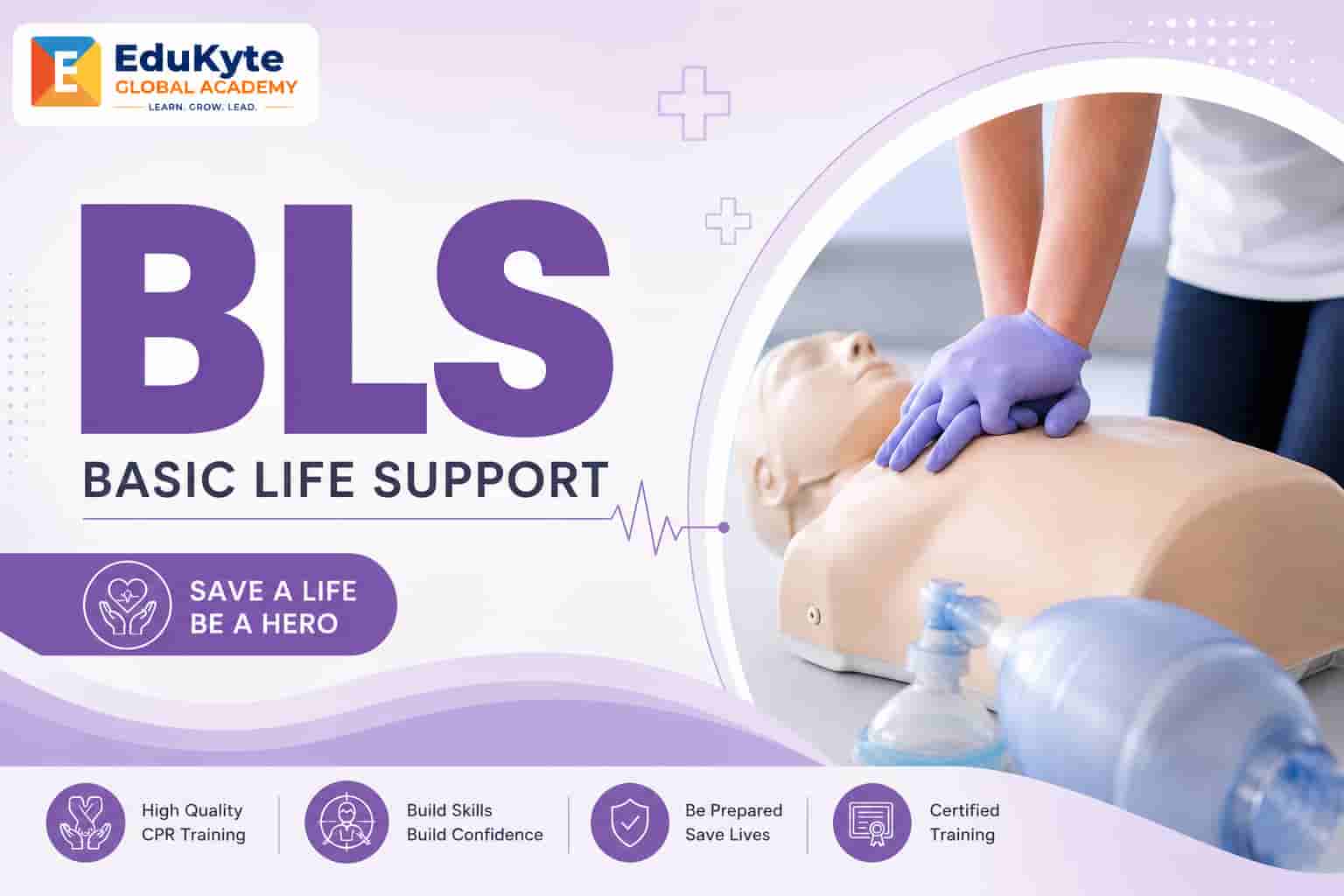
Basic Life Support
Instructor
What Will You Learn?
About This Course
EduKyte BLS (Basic Life Support)
EduKyte Basic Life Support (BLS) is a comprehensive life-saving training program designed to equip healthcare professionals, students, corporate employees, and the general public with the essential skills required to recognize and respond to life-threatening emergencies. The program focuses on early recognition of cardiac arrest, activation of emergency response systems, high-quality CPR, effective use of an Automated External Defibrillator (AED), and relief of choking in adults, children, and infants.
Delivered through interactive learning, hands-on practice, simulation-based training, and competency assessments, the EduKyte BLS program emphasizes confidence, teamwork, and rapid intervention during critical situations. Participants learn evidence-based techniques aligned with internationally accepted resuscitation guidelines, enabling them to provide immediate care until advanced medical help arrives.
The program supports EduKyte's mission of creating safer communities and empowering individuals with life-saving knowledge, ultimately improving survival outcomes during medical emergencies both within healthcare settings and in everyday life.
Requirements
Trusted Companies
+3200 Companies trusted our courses for their staff tutoring

FAQ
Check the frequently asked questions about this course.
ANAND EDWARD

Curriculum Overview
This course includes 14 modules, 16 lessons, and 1:40 hours of materials.
This video demonstrates the correct steps of One-Rescuer Basic Life Support (BLS) for adults, including scene safety assessment, recognition of cardiac arrest, activation of emergency response, and high-quality CPR. Learners will understand proper chest compression techniques, ventilation methods, and effective use of an Automated External Defibrillator (AED). The demonstration follows evidence-based resuscitation guidelines to help improve survival outcomes during cardiac emergencies.
Single Rescuer Adult Bls
Adult Chain of Survival – Summary
Ensure the scene is safe.
Check the patient's responsiveness.
Call for help and activate the emergency response system; obtain an AED.
Check breathing and pulse simultaneously for no more than 10 seconds.
If there is no pulse and no normal breathing (or only gasping), start high-quality CPR immediately.
Use the AED as soon as it is available and follow its prompts.
Continue CPR and AED use until advanced medical help arrives or the patient shows signs of life.
Adult BLS (Single Rescuer) – Summary
Ensure the scene is safe.
Check for responsiveness by tapping the shoulders and shouting.
If the patient is unresponsive, activate the emergency response system, get an AED (or send someone to retrieve it), and return to the patient.
Check breathing and pulse simultaneously for no more than 10 seconds.
If there is no pulse and no normal breathing (or only gasping), begin high-quality CPR.
Perform 30 chest compressions followed by 2 rescue breaths (30:2).
Compress the chest at a rate of 100–120 compressions/minute and a depth of 5–6 cm (2–2.4 inches), allowing complete chest recoil.
Use the AED as soon as it becomes available and follow the device prompts.
Continue CPR and AED use until the patient recovers, advanced healthcare providers take over, or you are unable to continue.
In two-rescuer BLS, Rescuer 1 assesses the victim, activates the emergency response system, checks breathing and pulse, and immediately starts high-quality CPR. Rescuer 2 responds to the emergency call by bringing the AED to the scene. Once Rescuer 2 arrives, the AED is applied, and the rescuers switch roles with minimal interruption—Rescuer 2 performs chest compressions while Rescuer 1 operates the AED and assists with ventilations. CPR and AED use continue until the victim recovers, advanced medical personnel take over, or the rescuers are unable to continue.
Mouth-to-Mouth: Used for adults and children when no barrier device is available.
Mouth-to-Mouth-and-Nose: Used for infants, covering both the mouth and nose with your mouth.
Mouth-to-Nose: Used when the victim's mouth cannot be opened or is severely injured.
Pocket Mask Ventilation: Provides a barrier between the rescuer and victim while delivering rescue breaths.
Bag-Mask Ventilation (BVM): Preferred for trained healthcare providers; most effective when performed by two rescuers.
Deliver each rescue breath over 1 second, just enough to produce visible chest rise.
Avoid excessive ventilation, as it may reduce the effectiveness of CPR and increase the risk of gastric inflation.
Head Tilt–Chin Lift: Preferred airway-opening technique for victims without suspected spinal injury.
Jaw Thrust: Used when head, neck, or spinal injury is suspected to minimize cervical spine movement.
If the jaw thrust does not open the airway, perform the head tilt–chin lift to ensure adequate ventilation.
Always confirm that the airway is open before delivering rescue breaths.
Automated External Defibrillator (AED)
An Automated External Defibrillator (AED) is a portable medical device that analyzes the heart's rhythm and delivers an electrical shock, if needed, to restore a normal heart rhythm during sudden cardiac arrest. It provides clear voice and visual prompts to guide rescuers through each step and should be used as soon as it becomes available while minimizing interruptions to CPR.
Child CPR is performed on children 1 year of age to puberty who are unresponsive, not breathing normally, and have no pulse or a pulse less than 60 beats/minute with signs of poor perfusion. After ensuring scene safety, check responsiveness, breathing, and pulse for no more than 10 seconds. Begin high-quality CPR with a compression rate of 100–120 compressions per minute and a depth of one-third of the chest (about 5 cm/2 inches). Use a 30:2 compression-to-ventilation ratio for a single rescuer and 15:2 for two rescuers. Apply an AED as soon as it is available and continue CPR until the child recovers, advanced medical personnel take over, or the rescuer is unable to continue.
Check responsiveness and call for help.
Assess breathing and brachial pulse for no more than 10 seconds.
If no pulse or pulse <60/min with poor perfusion, start CPR.
Place the heel of one hand on the center of the chest, just below the nipple line.
Compress one-third the chest depth (≈4 cm/1.5 inches) at 100–120/min.
Give 30 compressions followed by 2 rescue breaths.
Use an AED as soon as it is available and continue CPR until help arrives or the infant recovers.
Rescuer 1 checks responsiveness, breathing, and brachial pulse.
Rescuer 2 activates the emergency response system and brings the AED.
Use the two-thumb encircling hands technique for compressions.
Compress one-third of the chest depth (≈4 cm/1.5 inches) at 100–120/min.
Perform 15 compressions followed by 2 breaths.
Switch rescuers every 2 minutes with minimal interruption.
Use the AED as soon as it is available and continue CPR until the infant recovers or advanced medical help takes over.
Recognize severe choking and call for help.
Give 5 back blows between the shoulder blades.
If unsuccessful, give 5 abdominal thrusts.
Continue alternating 5 back blows and 5 abdominal thrusts until the object is expelled or the person becomes unresponsive.
If unresponsive, start CPR and use an AED as soon as available.
Recognize severe choking and call for help.
Give 5 back blows between the shoulder blades.
Follow with 5 chest thrusts (not abdominal thrusts).
Continue alternating 5 back blows and 5 chest thrusts until the object is removed or the person becomes unresponsive.
If unresponsive, start CPR and use an AED as soon as possible.
Recognize severe choking and call for help.
Give 5 back blows between the shoulder blades.
Follow with 5 abdominal thrusts.
Continue alternating 5 back blows and 5 abdominal thrusts until the object is expelled or the child becomes unresponsive.
If unresponsive, start CPR and use an AED as soon as available.
For a responsive choking infant, give 5 back slaps followed by 5 chest thrusts, repeating until the airway is cleared or the infant becomes unresponsive. If the infant becomes unresponsive, begin CPR, check for a visible object before giving breaths, avoid blind finger sweeps, and continue until advanced help arrives.
BLS Post Test
Quiz Certificate
Quiz Certificate
Course Certificate
This Course Includes
Course Specifications



Subscribe to Our Newsletter


Additional Links
Login Register Contact Certificate Validation Become Instructor About Terms and PoliciesContact US


Reply to Comment